The origins

Orchard meadows (lux: Bongerten) have long shaped the landscape of the Mëllerdall region. Until the mid-20th century, they served as the primary source of our fruit. Furthermore, we associate them with traditions such as the numerous pear and plum festivals, as well as traditional craftsmanship

To preserve these orchard meadows—which are of high importance in so many ways—for the long term, the “Natura 2000 verbindet” project from the Nature and Geopark Mëllerdall is committed to replanting and maintaining high-stemmed fruit trees and promoting the use of orchard fruit. The Kierfchen.lu platform was created as part of this project. Originally, the bulletin board map was designed only for the Mëllerdall region, but in the spring of 2025, the platform was opened to the entire country.

The project is 100% funded by the Ministry of the Environment, Climate, and Biodiversity through the Fonds pour la protection de l’environnement.
The story behind

Maintaining an orchard meadow (lux: Bongert) is time-consuming and labor-intensive. These days, the fruit often remains unused and many orchards fall into disrepair.

With Kierfchen.lu we aim to bring together people interested in fruit (and fruit trees) and thereby promote the use of this traditional cultural element – from grassland management and tree care to product marketing. Kierfchen is not only about untreated fruit, but also about providing a platform for everyting related to orchards. The platform aims to highlight just how diverse orchards are.

Use Kierfchen and discover the diversity of orchard meadows!

How does it work?

The platform allows users to search for or post adverts in various categories, enabling everyone interested in fruit, fruit trees, and orchards to connect with one another. Everyone is welcome on Kierfchen: fruit tree owners can offer their fruit, while consumers and producers can purchase it. Businesses, such as regional producers and restaurants, also find a platform for marketing their products on Kierfchen.lu. Furthermore, you can search for beekeeping sites, leased land, machinery, and much more.

You can also use the “Share” feature on each individual adverts to expand your reach via social media or simply by email or various chat platforms. We reserve the right to reject adverts that we deem inappropriate.

Learn more about the individual categories here:


Fruits & Nuts

Without any doubt, this is the platform’s most important category!

It allows you to search specifically for:

  • Apples,
  • Pears,
  • Cherries,
  • Mirabelle plums,
  • Quinces,
  • Plums (including common plums and Renekloden) as well as
  • Chestnuts and
  • Walnuts

—all types of fruit and nuts traditionally grown in an orchard.

Anyone looking for fruit or wanting to offer some can post here: whether from a single tree in the garden or from an orchard meadow, whether anonymously or with contact details. Explore the variety of flavors in our local fruit and be inspired by the diversity of varieties!

Also check out our fruit(growing) seasonal calendar with information on harvest and storage periods as well as on planting and caring for fruit trees, and really use the “Share” feature for the adverts.

Kierfchen and Gielt Band go hand in hand.

This filter function is primarily intended for people looking for fruit and nuts and allows you to specifically select listings:

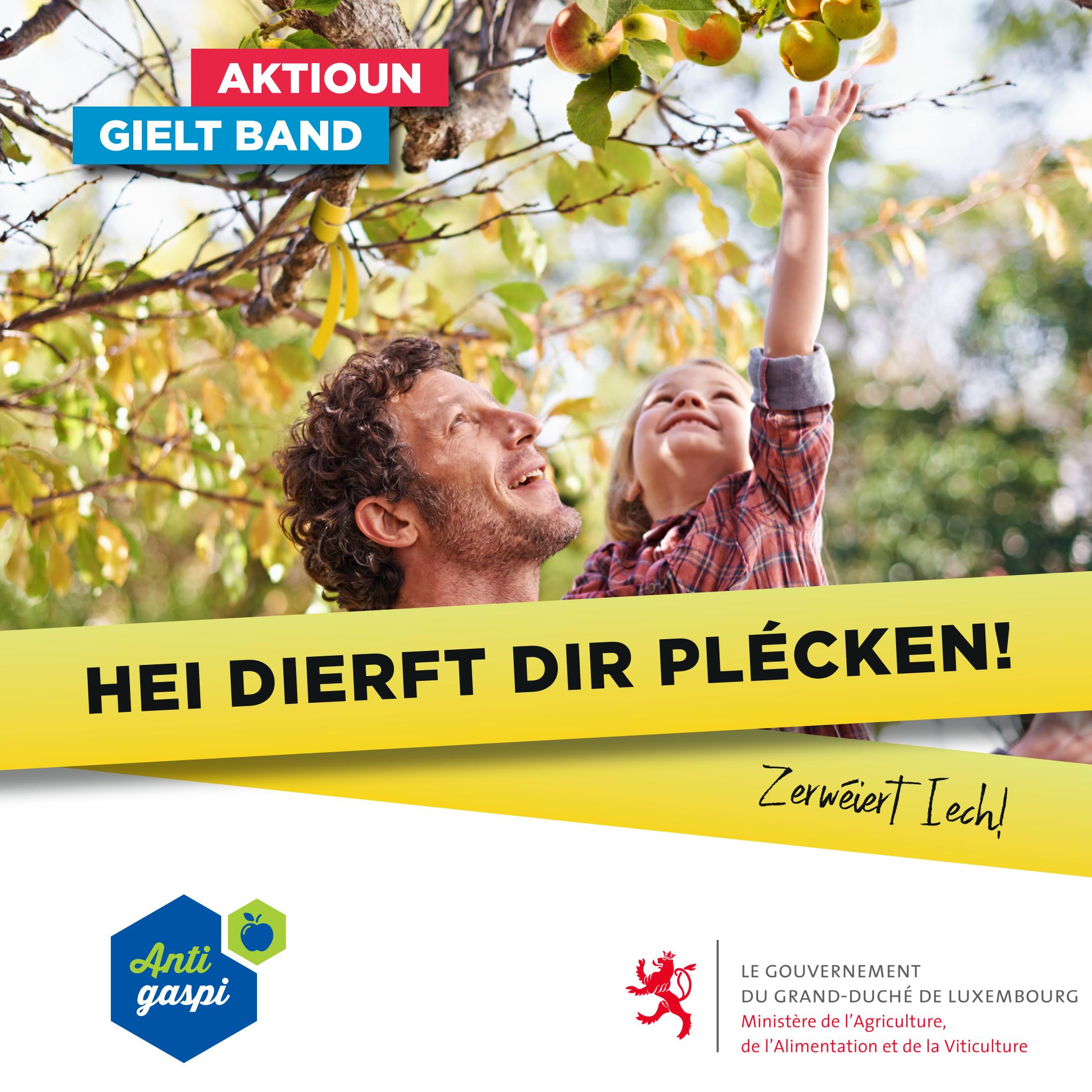
  • where you can pick fruit/nuts largely contact-free. (Filter: Only “Gielt Band”) → Here, the owner is participating in the “Gielt Band” campaign, meaning these trees are marked with a yellow ribbon. OR
  • where you are permitted to pick fruit/nuts, or pick up pre-picked fruit/nuts, after prior contact. (Filter: Without “Gielt Band”) → Here, the owner is not participating in the “Gieltt Band” campaign and therefore decides independently on the location details, meaning no marking of the trees is required.

Note: The “Gielt Band” campaign is managed by the Ministry of Agriculture, Food, and Viticulture. A complete list of municipalities and private individuals participating in the “Gielt Band” campaign, as well as further information, can be found here. The “Gielt Band” listings were largely taken over from antigaspi.lu and are visible year-round, i.e., even when it is not currently in season.

When placing an ad, fruit and nut sellers have the option to mark their ad as part of the “Gielt Band” campaign. The yellow ribbons are available from the Ministry of Agriculture, Food, and Viticulture.

Work

Unlike wild fruit trees, cultivated fruit trees require our attention if we are to be rewarded with a bountiful harvest. Pruning correctly at the right time is crucial for the tree’s healthy development. There are also a few points to keep in mind when planting. Are you unsure about what matters most?

The Biological Station in your region is the right place to turn to for questions on topics such as:

  • orchards (Bongerten)
  • Funding programs
  • current projects on nature and species conservation

Use the “Advice” filter to find the locations of the Biological Stations:

  • Natur- & Geopark Mëllerdall: BEAUFORT
  • Naturpark Our: HOSINGEN
  • Naturpark Öewersauer: ESCH-SAUER
  • SIAS: SENNINGERBERG
  • SICONA: OLM

Note: Not sure which Biological Station your municipality belongs to? Then check here!

Maintaining a Bongert also involves caring for the meadow where the trees stand. Appropriate grazing (or mowing) is crucial both for the biodiversity of animals and plants and for the vitality of the fruit trees.

  • Are you looking for a new place for your “baa-ing” workers to work? OR
  • Do you need hardworking “baa”-workers to care for your orchard? OR
  • Have you ever tried raising chickens in an orchard?

Traditionally, orchards are grazed by sheep, as they graze low to the ground, are better able to utilize the often roughage-rich forage, and, due to their lower body weight, do not significantly impair soil aeration around the fruit trees. Depending on the choice of grazing animals and the age of the fruit trees, it is essential to protect individual trees from browsing, abrasion, and uprooting using so-called grazing protection cages.

Note: If you have questions about grazing protection cages, please contact the Biological Station in your region.

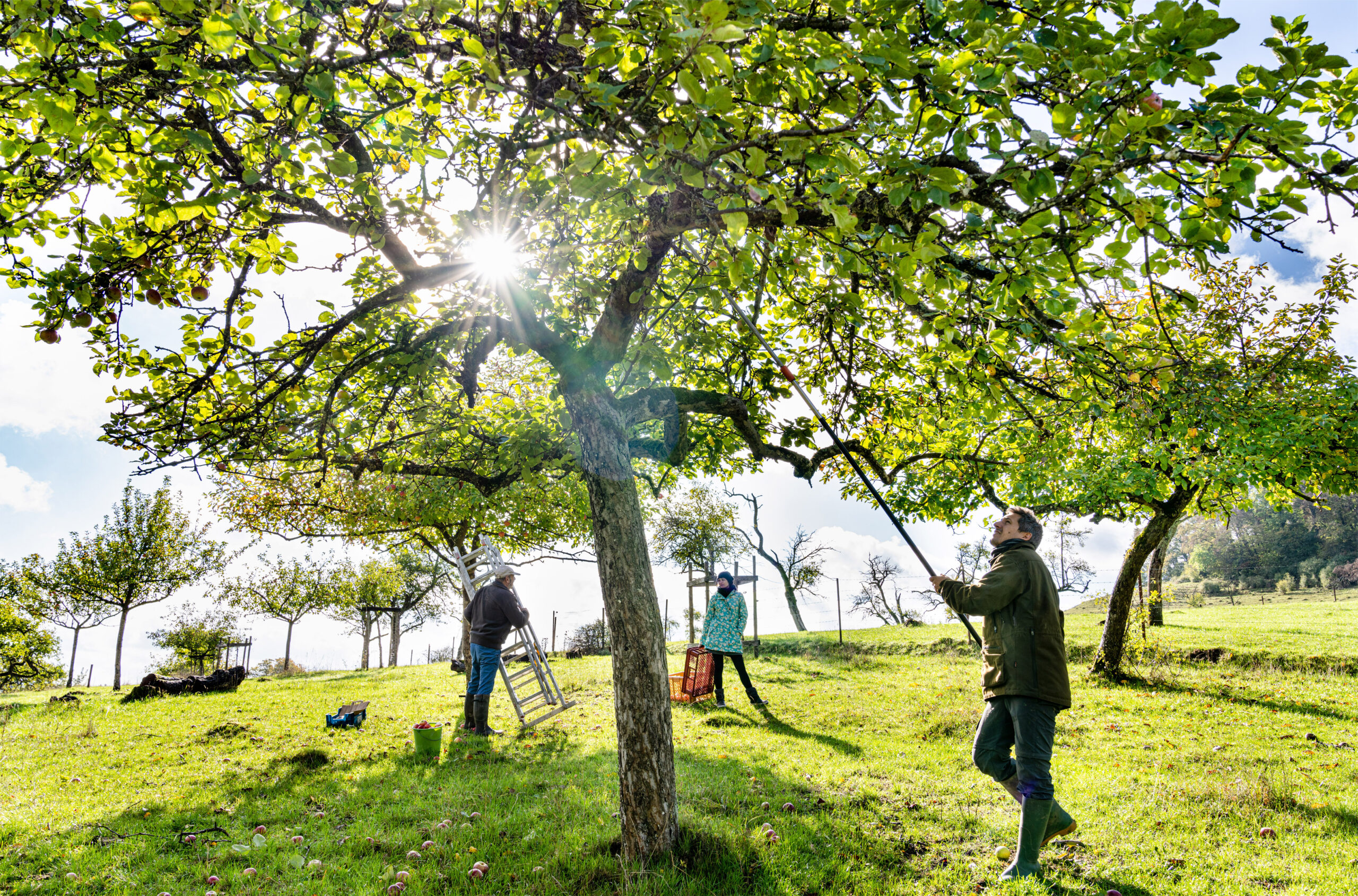
Harvest time is very labor-intensive, so fruit is often left unpicked due to a lack of help. A well-maintained high-stemmed fruit tree can produce an average of about 300 kg of fruit at full yield. (It has been shown that the yield decreases for neglected trees.) Many helping hands are needed to harvest and make use of all this fruit.

Are you:

  • up for a workout in the great outdoors?
  • Want to do something for nature conservation, local agriculture, or community support at the same time?
  • Interested in untreated, locally grown fruit?

Or are you looking for:

  • motivated people with plenty of helping hands
  • who bring fun and good spirits
  • and enjoy fruit and its products

Then post your ad today!

Note: The platform operator does not provide harvest helpers. We can only assist you in creating an ad.
Tip: Plan a fruit-picking event during our “Mount vum Bongert” (see the “Event”-category)—we may be able to help you promote your event.

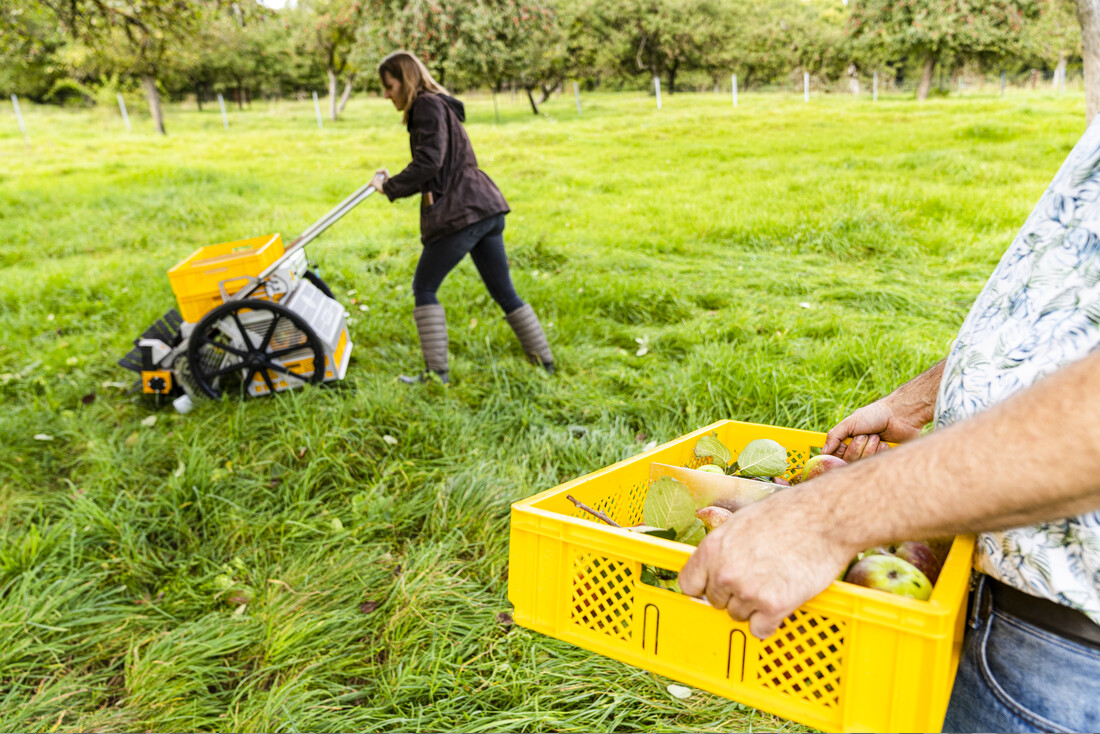
From tree care to harvesting and processing, a variety of tools are required. While smaller tools like pruning shears are easy to buy on your own, the situation may be different when it comes to harvesting machines (such as “Obstraupe”) or tools for processing fruit (juicers, dehydrators).

Use this category to:

  • search specifically for equipment OR
  • offer your own equipment for rent or sale.

Note: As part of the “Mount vum Bongert” initiative, you can rent a Rollblitz from the Nature & Geopark Mëllerdall.

Business

Preserving our national cultural heritage, the Bongert, can only succeed if we actually use its produce! With this category, we aim to offer regional producers a free platform to market their products. At the same time, discover the wide variety of high-quality products that can be created from a Bongert, whether directly through fruit processing:

  • Fresh table fruit,
  • dried fruit,
  • juice, cider, wine, sparkling wine, gin, etc.
  • jam

or indirectly through farming:

  • honey,
  • meat and sausage products,
  • wool products,
  • dairy products

Immerse yourself in an incomparable taste experience as you explore the variety of products offered by regional producers.

Note: If you are a regional producer and would like to add a photo to your listing, please contact us briefly. (Unfortunately, we cannot guarantee that the products offered here actually come from a Bongert—please check with the producer regarding this.)

Preserving our national cultural heritage, the Bongert, also involves using the products grown here. In this category, you can discover restaurants that have taken on the task of processing or using, for example, fruit from the Bongert and have previously participated in the annual “Mount vum Bongert” (see category: Events) with a corresponding menu.

Perhaps this free platform can also encourage other restaurants to use products from the Bongert.

Here is a small selection of dishes from recent years:

  • Marinated grilled pumpkin from Lilienhaff, quince chutney, and Berdorf goat cheese
  • Wild boar ragout from our own hunt with apples and croquettes
  • Refreshing quince sorbet with a hint of verbena

Note: If you are a restaurant and would like to add a photo to your listing, please contact us briefly. (Unfortunately, we cannot guarantee that the products offered here actually come from a Bongert—please check with the restaurant regarding this.)

Other

Without bees, there would be no (or very, very little) fruit!

The main players in flower pollination are clearly wild bees and honeybees. So:

  • Secure your fruit harvest and provide a place for bees to settle. OR
  • Find the right location for your bee colony here.

Also remember to create nesting sites for wild bees by providing: open patches of ground, deadwood, piles of stones, or dead stems with pith, or contact the biological station in your region for information on suitable nesting aids.

Note: You can find further (technical) information on setting up beehives here. Learn more about additional measures to promote insect diversity here.

Was wäre all die Arbeit rund um Obst(bäume), wenn es nichts zu feiern gäbe?!

Mit Anerkennung der „Kultur vun de Bongerten“ als immaterielles Kulturerbe, bietet diese Kategorie ein Schaufenster speziell für Aktivität(en) rund um Obst(bäume). Inserieren bzw. finden Sie hier:

  • Feierlichkeiten, wie z.B. Vizfeste,
  • Erleben mit allen Sinnen, wie z.B. Produktverköstigungen, Pflückevents
  • Sport- und Erholungskurse, wie z.B. Yoga oder
  • Weiterbildungskurse, wie z.B. Schnittkurse, Kräuterwanderungen

Warum nicht mal eine kleine Auszeit genießen: mitten im Bongert ein Buch in der (mit Decken gefüllten) Badewanne lesen und sich dabei von regionalen Produkten verwöhnen lassen? Der Fantasie für Events / Aktivitäten sind keine Grenzen gesetzt (sofern sie mit dem Naturschutzgesetz vereinbar sind).

Hinweis: Findet Ihr Event im September / Oktober statt? Dann nehmen Sie gerne Kontakt zu uns auf, damit Sie Teil von unserem „Mount vum Bongert“-Programm werden können und somit von weiterer Werbung für Ihr Event profitieren können. Sie können Ihr Inserat auch schnell und einfach über verschiedene Kanäle teilen.

Tipp: Wir leihen Ihnen gerne unseren „Kierfchen-Baum“ als interaktives Element für Ihr Event aus. Für weitere Details nehmen Sie bitte Kontakt zu uns auf.

What would all the work involved with fruit (trees) be for if there were nothing to celebrate?!

In recognition of the “Kultur vun de Bongerten” as intangible cultural heritage, this category serves as a showcase specifically for activities related to fruit (trees). Post or find listings here:

  • Celebrations, such as harvest festivals,
  • Experiences for all the senses, such as product tastings and picking events
  • Sports and recreation courses, such as yoga, or
  • Educational courses, such as pruning classes and herb walks

Why not enjoy a little break: reading a book in a bathtub (filled with blankets) in the middle of the Bongert while indulging in regional products? There are no limits to your imagination for events and activities (as long as they comply with the Nature Conservation Act).

Note: Is your event taking place in September or October? If so, please feel free to contact us so you can be part of our “Mount vum Bongert” program and benefit from additional promotion for your event. You can also share your listing quickly and easily through various channels.

Tip: We’d be happy to lend you our “Kierfchen Tree” as an interactive element for your event. Please contact us for more details.

Preserving our national cultural heritage, the Bongert, requires a lot of work, a healthy dose of optimism, and sometimes even the courage to try something new—especially when it comes to marketing your Bongert.

  • Would you like to take on the challenge of taking over an existing Bongert or creating a new one, perhaps even as an agroforestry project? OR
  • Are your strength and energy waning, and are you looking for someone who will continue to cherish your Bongert—someone to whom you can entrust your legacy?

Then place your ad today—we wish you the best of luck and success!

Land is a valuable asset, and sometimes it’s hard to take proper care of it.

  • Are you looking for someone to manage your farmland or simply handle its underutilization (grazing/mowing)? OR
  • Do you enjoy working outdoors in nature and love fruit? OR
  • Are you looking for a shady spot for your chickens, sheep, cows, etc.?

Then you’ll find the perfect piece of land to lease—or the right tenant for your property—on kierfchen.

Become part of Kierfchen

Sie Sind auf der Suche nach frischem. ungespritztem Obst für hausgemachte Marmelade? Sie wollen selbst einen Bongert anlegen, Ihnen fehlt aber noch das passende Grundstück? Brauchen Sie Hilfe bei der Ernte? Haben Sie Platz bei Ihren Obstbäumen um einen Bienstock aufzustellen?

What is the "Gielt Band" campaign?

Bei der Aktion “Gielt Band” des Ministeriums für Landwirtschaft, Ernährung und Weinbau können Obstbäume mit einem gelben Band von dem jeweiligen Besitzer markiert werden.  Das gelbe Band am Baum signalisiert, dass der Besitzer des Baumes die Ernte des Obstes ausdrücklich erlaubt, ohne dass eine vorherige Rücksprache stattfinden muss. Ziel ist es, dass möglichst viel lokales Obst verwertet wird. Mitmachen können Gemeinden, Vereine und Firmen mit Bäumen an öffentlichen Plätzen, aber auch Privatpersonen.

Auf Kierfchen findet man über die Karte den Großteil dieser Bäume (für die es ausreichend Standortinformationen gibt). Alle Anzeigen, die Teil dieser AntiGaspi-Kampagne sind, sind an dem gelben Banner und dem AntiGaspi-Logo erkennbar. Es gibt auch eine Filterfunktion, die es ermöglicht diese Anzeigen auf der Karte ein- oder auszublenden.

Eine komplette Liste der Obstbäume je Gemeinde sowie ein Bestellformular für die gelben Bänder finden sie auf der Webseite antigaspi.lu.